Welcome to Discovery-Sci
The ZytoLight ® SPEC BIRC3/MALT1 Dual Color Dual Fusion Probe is designed to detect translocations involving the chromosomal region 11q22.2 harboring the BIRC3 (baculoviral IAP repeat containing 3, a.

ZytoLight ® SPEC BIRC3/MALT1 Dual Color Dual Fusion Probe

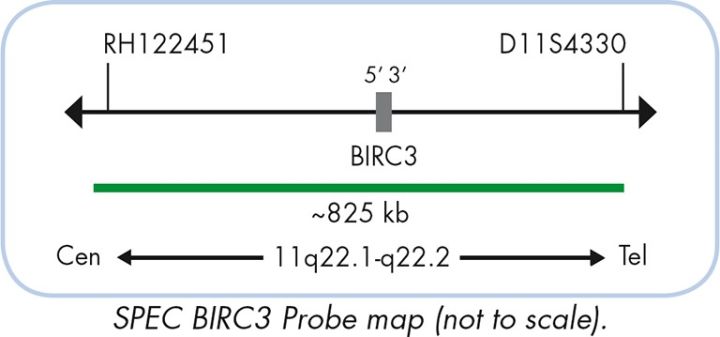
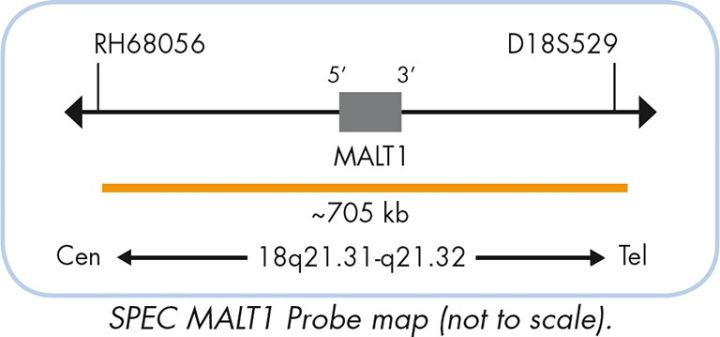
The ZytoLight ® SPEC BIRC3/MALT1 Dual Color Dual Fusion Probe is designed to detect translocations involving the chromosomal region 11q22.2 harboring the BIRC3 (baculoviral IAP repeat containing 3, a.k.a. API2) gene and the chromosomal region 18q21.32 harboring the MALT1 (mucosa associated lymphoid tissue lymphoma translocation gene 1, a.k.a. MLT) gene. The recurrent translocation t(11;18) (q22.2;q21.3) is frequently found in mucosa- associated lymphoid tissue (MALT) lymphoma which represents the most common extranodal B-cell tumor and accounts for 5-10% of all non-Hodgkin lymphoma. The translocation results in the expression of chimeric fusion transcripts comprising the N-terminal end of the apoptosis inhibitor BIRC3 which is highly expressed in adult lymphoid tissue and C-terminal parts of the MALT1 protease. The BIRC3/MALT1 fusion protein was shown to induce proteolytic cleavage of NF-kappa-B-inducing kinase (NIK) ultimately resulting in constitutive non-canonical NF-kappa-B signaling, enhanced B-cell adhesion, and apoptosis resistance. It is assumed that disruption of the BIRC3-NIK interaction and/or blocking of MALT1 protease or NIK kinase activity could represent new treatment approaches for refractory t(11;18)-positive MALT lymphoma.

Related Files